Total Material Conversion.
The four Carbotura Protocols collectively achieve Total Material Conversion (TMC) — designed to convert virtually all incoming manufacturing feedstock into saleable manufactured materials, recovered energy, and ultrapure water with near-zero residual, near-zero emissions, and near-zero discharge.
The system operates without combustion in an anoxic environment. 35 modular technologies in precise orchestration. Every stage engineered to maximize material recovery and minimize environmental impact.
The Recyclotron uses Microwave Catalytic Reforming — a molecular electromagnetic activation process, not gasification or pyrolysis. It is designed to operate without combustion or oxidation in an anoxic environment.
Each 400 TPD modular factory generates 857 MWh daily — fully self-powered and grid-independent with approximately 5% reserve buffer.
Built on multi-phase molecular technology deployed since 1997. Carbotura's innovation is the proprietary integration and sequencing — not unproven science.
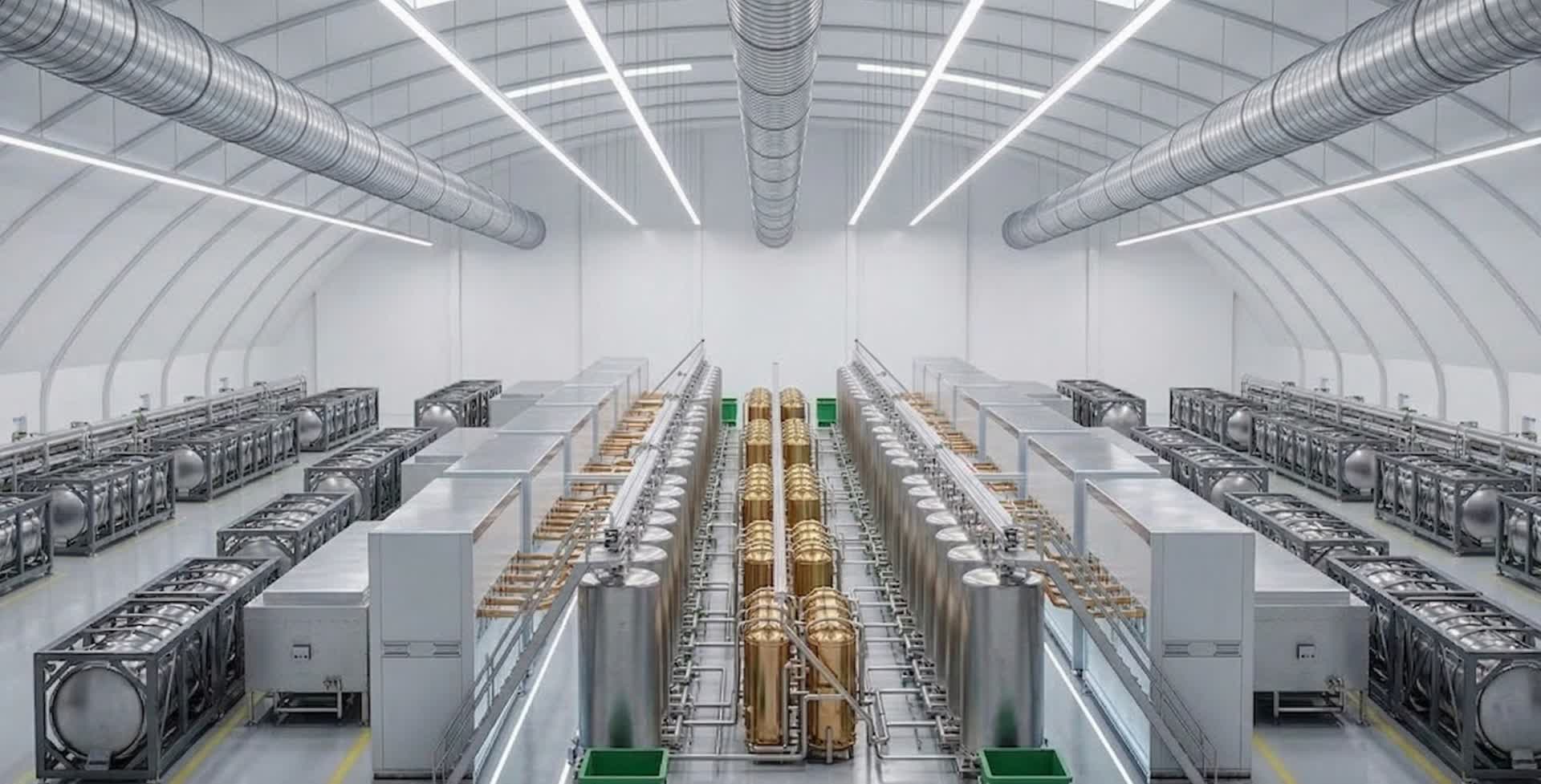
Pregenesis — Feedstock Preparation
Incoming manufacturing feedstock delivered by Feedstock Haulers is shredded, metals separated magnetically, and liquids extracted (Liquifact™). Prepared feedstock flows directly into the Regenesis system as the standard operating mode. Direct feed is always the primary pathway. Standardized Manufacturing Units (SMUs) are produced only as a buffer storage option when operational conditions require it.
Mixed manufacturing feedstock enters without community-side sorting. All separation occurs within the modular factory under controlled industrial conditions.
Liquid fraction extracted during shredding and compression. Routed to water processing systems where it is refined into ultrapure water — a saleable manufactured product.
MSW, coal, coal ash, tires, rubber products, and mining tailings — each following optimized preparation pathways into Regenesis.
~300 TPD flows to Regenesis (direct feed or via SMU buffer), 60 TPD extracted as Liquifact™ for water processing, 40 TPD separated as metals for direct recovery.
Regenesis — Feedstock Disintegration
The primary output of the Regenesis Protocol is OmniCrude™ — the molecularly disintegrated, elementally rich intermediate state produced when feedstock is broken to its molecular level. OmniCrude™ is not the feedstock. It is what feedstock becomes — the Carbotura equivalent of crude oil leaving the wellhead. Regenesis MAX is the refinery that selectively refines OmniCrude™ into the full product portfolio.
The Recyclotron Multiphase Microwave Reactor — one integrated manufacturing system — uses Microwave Catalytic Reforming at 650°C+ in an anoxic (no oxygen) environment to break manufacturing feedstock to its molecular level. No combustion. No oxidation. No flame. No stack.
650°C+ operating point. Ambient to 3,000°C in fine increments depending on material stream.
915 MHz microwave energy. Selects materials via resonant frequency or weak bond targeting.
Anoxic (zero oxygen). No combustion air supply. No flame. No oxidation reaction.
Up to 16 material streams in a single pass. Post-processed sorting of carbon, metals, silica.
Regenesis MAX — Materials Refining
Molecular outputs from Regenesis are refined through multiple advanced processes, transforming raw molecular outputs into high-value manufactured materials entering the RevCon™ Valorization Ladder.
1,800°C — produces activated carbon, carbon black, carbon fibers.
3,000°C — produces synthetic graphite, graphene, fullerenes. The EcoGraph™ product line.
Designed for complete PFAS/PFOS molecular breakdown at 1,200°C+. Carbon-fluorine bonds — the strongest bonds in organic chemistry — broken to their atomic elements.
Green hydrogen and specialty aromatics produced at commercial specifications.
Precious metals, rare earth elements purified and recovered at commercial specifications. Au 0.2 PPM · Ag 2 PPM · Pt 0.05 PPM · Nd 0.1 PPM per metric tonne of feedstock.
Ultrapure water — 87,000+ gallons/day per 400 TPD factory. Meets semiconductor and pharmaceutical grade specifications.
CO₂ outputs are managed as manufactured products — not emissions. Three pathways: (1) cracked into carbon products via Regenesis MAX, (2) mineralized into construction-grade materials (45Q eligible at $85/ton), (3) purified as industrial-grade or food-grade CO₂ for commercial sale.
Exogenesis — Urban & Landfill Mining
Exogenesis is a precursor protocol to Pregenesis, deployed when the feedstock source is a legacy deposit requiring excavation and conditioning before entering the standard manufacturing sequence. The distinction is source, not material type — any feedstock can arrive via direct delivery or via Exogenesis.
Legacy utility deposits with recoverable silica, alumina, iron oxides, and rare earth elements. Historical liabilities converted to feedstock.
Residual material from ore processing containing recoverable metals, mineral compounds, and rare earth concentrations.
Closed landfill material extracted and conditioned. Often contains higher concentrations of valuable metals than daily municipal flows.
PFAS-contaminated soils converted from environmental liability into manufacturing feedstock. Designed for complete PFAS/PFOS molecular breakdown at 1,200°C+ through Regenesis.
Exogenesis → Pregenesis → Regenesis → Regenesis MAX → RevCon = Total Material Conversion. Once material passes through Exogenesis, it follows the identical manufacturing pathway as any other feedstock.
APS Product Recovery
The Atmospheric Protection System creates a negative pressure environment inside the entire facility. If there is ever a tiny leak, clean air rushes in from outside rather than process vapors escaping. Containment is automatic and continuous.
60,000 m³/hr — comprehensive capture across the entire facility.
−0.2 bar differential — constant negative pressure throughout the facility envelope.
1,200 metric tons of fugitive hydrocarbons captured annually and reprocessed.
$7.7M/year at $7,500/ton synthetic graphite — liability converted to revenue.
RevCon — The Value Ladder
RevCon measures how refined a material is. Each tier raises quality and revenue potential. RevCon 3 is always the conservative baseline for all financial projections. RC4–5 are upside scenarios only.
Full System Map.
Complete feedstock-to-product taxonomy across all four protocols, six material families, and five RevCon tiers. Includes module IDs, CAPEX data, and revenue ranges.