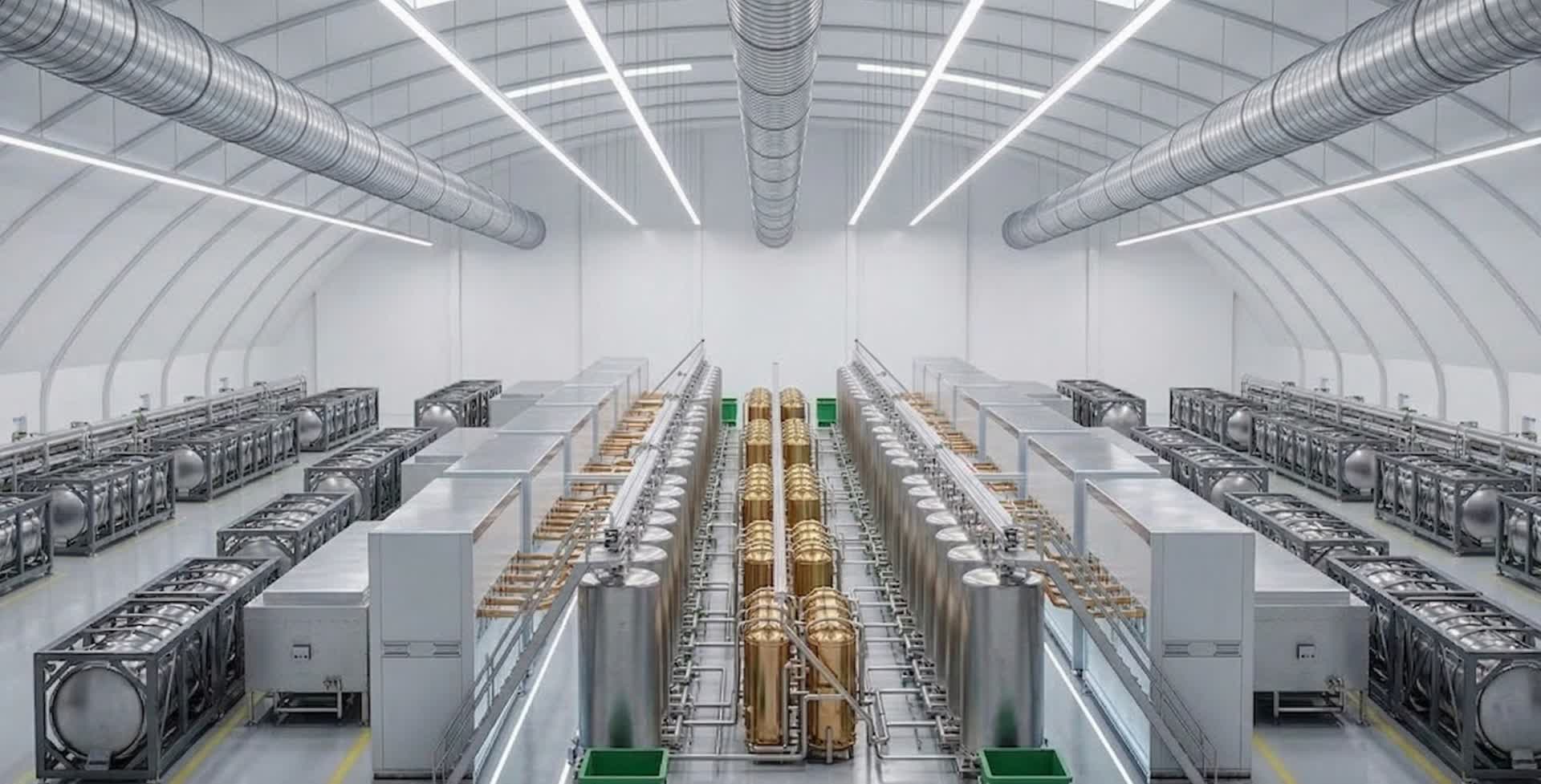
Elemental recycling,
engineered as manufacturing.
Carbotura's Advanced Circular Manufacturing (ACM) platform refines end-of-life material streams into more than 100 refined industrial products — through primary elemental dissociation, not combustion, and not sorting.
Navigate with → arrow keys, swipe, or the dots below.
What the industry classifies as MSW is a periodic-table inventory.
There is no special "waste element" on the periodic table. Just 16 elements account for over 99% of the municipal solid waste (MSW) stream by mass — and every industry classification is simply a different elemental recipe of the same table.
Elemental data: EPA & ASTM MSW characterization (dry basis), Carbotura Intelligence Hub §12 — the full elemental reference →. Values indicative; composition varies by region and season.
Where the feedstock comes from.
Everything manufactured begins as six raw-material families. At end of life those products become the waste-classified streams your community manages today — and every one of them is accepted ACM feedstock, sorted or unsorted.
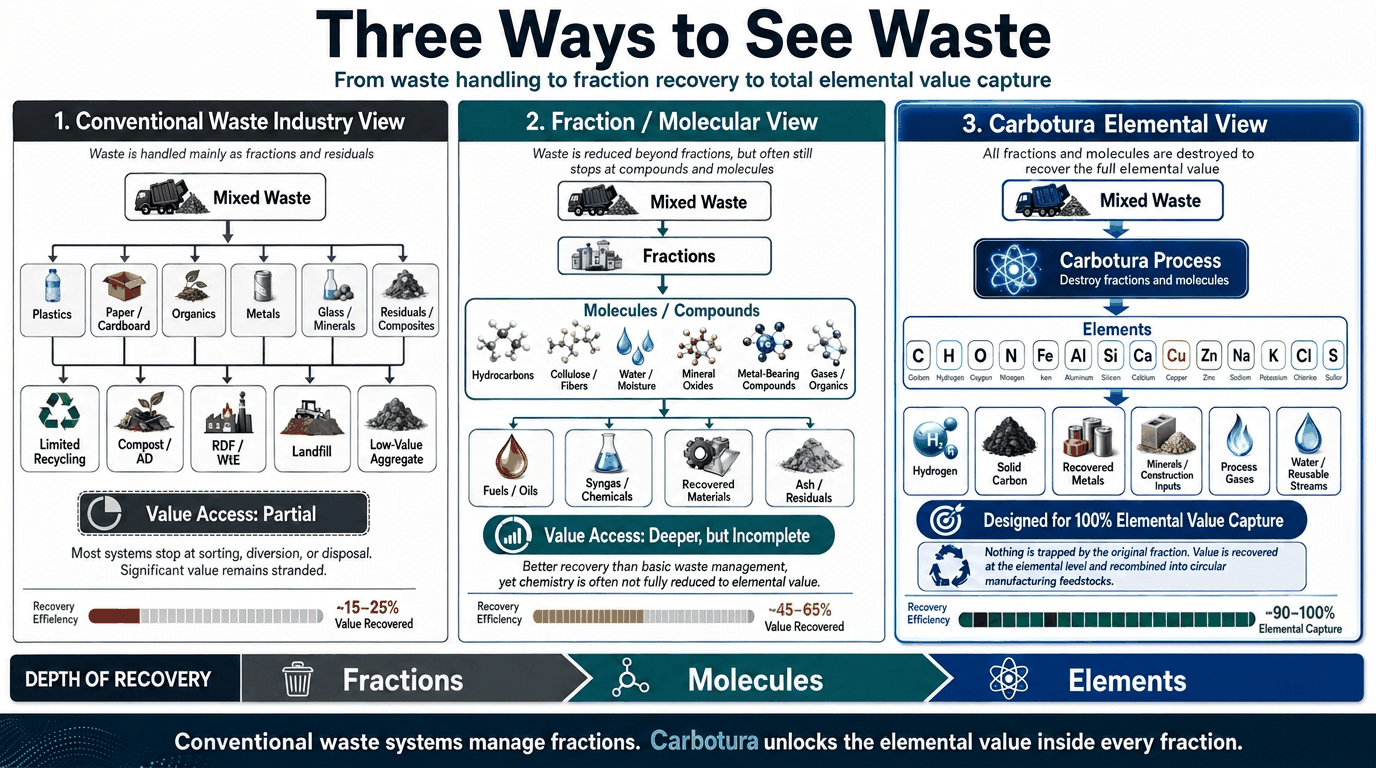
Not incineration. Not sorting. Elemental recycling.
ACM treats every incoming stream as a periodic-table inventory. The process performs primary elemental dissociation — no polymer or molecule survives — and refined products are synthesized from the recovered elemental constituents.
- A manufacturing platform — feedstock in, refined industrial products out
- Primary elemental dissociation — materials are taken to their elemental constituents, then rebuilt as products
- Closed Loop, non-oxidative processing — no combustion chemistry anywhere in the train
- Self-powering, Island-Mode facilities — grid-independent operation
- Pregenesis™ — feedstock reception and preconditioning
- Regenesis™ — the core dissociation train; the Recyclotron™ reactor is a module within it
- Regenesis MAX™ — separation and refining of both output streams into finished products
- Exogenesis™ — legacy-deposit remediation (optional add-on)
- Not incineration — an active nitrogen purge and vacuum keep the vessel absolutely oxygen-free
- Not waste-to-energy — Carbotura sells refined materials, not power, electricity, or fuel
- Not a sorting plant — heterogeneous, unsegregated streams are accepted directly
- Not a waste disposal site — every ton is converted into manufactured products, never buried or stored
Take it apart. Then only separate.
Four protocols, one reactor. Everything left of the Elemental Floor is taken apart to its elements; everything right of it is separated and refined. No input molecule survives the Recyclotron™.
Three ways to put energy into material.
Pyrolysis heats a vessel to heat what's inside it. Waste-to-energy burns the material itself to raise steam. Carbotura does neither — microwave energy couples directly into the material, heating it from the inside out while the vessel itself is never heated.
- Heat path: wall → inward, by conduction — slow and uneven
- The trade: many designs burn feed or syngas to fire the vessel — spending product to make heat
- Result: temperature gradients drive tar formation and inconsistent output
- Heat path: the material is the fuel — full oxidation to raise steam
- The trade: every material's value is destroyed for one product: heat
- Result: combustion byproducts, ash, and nothing left to refine
- Heat path: volumetric — the material heats from within, instantly and uniformly
- The trade: none — energy goes into bond scission, not into heating steel or making flue gas
- Result: nothing oxidizes; every element survives to be recovered and refined
Typical ranges from process-engineering and industrial-microwave literature — pyrolysis loses energy to vessel/wall conduction losses (and, in autothermal designs, to burning product just to fire the vessel); waste-to-energy's figure is the well-documented net electrical efficiency of a combustion-boiler-turbine cycle after thermodynamic (Carnot) losses. Microwave's advantage is mechanistic, not incremental: energy couples directly into the material itself rather than through an intermediate vessel-heating or combustion step.
Inside the Recyclotron™ — the Multiphase Microwave Reactor.
A closed, non-oxidative, vertical thermochemical synthesis and refining vessel. Highly heterogeneous, unsegregated feedstock becomes a standardized internal intermediate (OmniCrude™); final commodity finishing and ISO/ASTM certification happen in downstream separation modules.
Atmospheric boundary control
An active nitrogen purge and vacuum system maintain an absolutely non-oxidative environment — no oxygen means no combustion chemistry and no combustion byproducts, by physics rather than by after-treatment.
Volumetric processing
Microwave coupling heats the material volumetrically — from within the mass itself — rather than from the vessel walls. That is what allows highly mixed, multi-layered feedstock to be processed without upfront mechanical sorting or pre-drying.
Three zones, one continuous vertical vessel.
Feedstock enters at the top with recycled process media; two output streams leave — OmniCrude™ Vapor from the top, and OmniCrude™ Solids managed metal / mineral solids from the bottom. Both are internal intermediates, never sold as-is.
Top feed & initial conversion
Incoming material meets an intense microwave-coupled zone — instantaneous volumetric heating drives rapid bond scission and devolatilization, the start of elemental dissociation.
Freeboard vapor conditioning
Rising reactive gases get an optimized short residence time; continuous interaction with suspended mineral fines accelerates vapor simplification and suppresses tar formation catalytically.
Fluidized bed & solids discharge
Bottom-injected steam drives fluidization and reactive stripping of residual char; unreacted minerals and unaltered elemental metals discharge continuously through a controlled physical boundary.
Microwave-coupled reagent
High-efficiency dielectric susceptor — distributes heat uniformly across a heterogeneous solids matrix.
Catalytic surface
Residual mineral oxides reform hydrocarbon vapors in-flight, suppressing heavy-tar formation.
Steam stripping reactant
Enhances gas–solids contact and converts residual carbon fractions in the lower bed.
Nitrogen isolation barrier
Prevents oxidation entirely — no combustion byproducts to capture afterward.
Two multiphase streams, one vessel.
The Recyclotron™ performs primary elemental dissociation, resolving feedstock into OmniCrude™ Vapor and OmniCrude™ Solids — both internal intermediates, never sold as-is. Regenesis MAX™ separates and refines each into finished Circular Materials.
- BTX aromatics — precise thermal and pressure profiles isolate high-purity benzene, toluene, and xylene fractions
- Clean, predictable species — volumetric energy transfer prevents secondary recombination, bypassing heavy-tar formation
- High-purity hydrogen is released from aliphatic C–H cleavage — and consumed internally as Island-Mode process energy. Hydrogen is never sold; it is how the facility powers itself
- Downstream: CRSRU (Carbon Recovery Syngas Reforming Unit — secondary reforming) and Water Gas Shift (shift conversion) condition the stream before Regenesis MAX™ separates it into finished materials
- Engineered carbon — recovered solid carbon upgraded to activated carbons, thermal black, synthetic graphite, and graphene structures
- Unoxidized metals — aluminum, copper, and steel do not couple destructively with the microwave field; they exit structurally intact, ready for secondary smelting
- Clean mineral aggregates — glass and mineral fractions pass through under 650 °C unaltered, never vitrified
- Concentrated strategic elements — organic layers stripped from micro-components and electronic scrap concentrate rare earths (neodymium, dysprosium) and technological metals, ready for magnetic, density, and eddy-current classification
Six refining lines × five valorization grades.
Downstream of the reactor, Regenesis MAX™ refining lines separate and refine the recovered elements into finished product classes — over 100 refined products across the Circular Materials catalog.
What one ton is worth.
Every legacy option balances its books with public money — gate fees, tax levies, energy credits. None creates a value-added margin from the material itself. ACM converts the same ton into refined manufactured products and pays the community a royalty on it.
Cost figures: published U.S. tipping-fee and MRF processing analyses (2024) + the published ACM comparisons. Composting/AD figures are order-of-magnitude estimates. GHG figures: published U.S. waste-sector inventories (indicative per-ton basis). All figures indicative — not an offer; commercial terms are set under a Circular Supply Agreement (CSA).
Every dollar flow, by counterparty.
Cash coming in to Carbotura is highlighted. The Beneficiation Fee and the Circular Royalty™ are separate gross transactions and are never netted.
This is not an EPC project. It's a manufactured product.
Carbotura does not operate under an Engineer-Procure-Construct model. ACM Modular Production Units are manufactured products under Design for Manufacturability (DFM) — built to a locked production specification (multiphysics simulation as the a priori spec, 2.5% manufacturing tolerance), replicated for capacity. In EPC every risk runs live at once; in ACM each is retired before the next begins.
For a feedstock provider: the facility arrives as a manufactured, integrated product on a manufacturing schedule — not a construction project whose risk you share. Read the full EPC vs DFM primer →
Every ton is accounted for.
No upfront sorting or pre-drying
Total volumetric processing eliminates the capital-intensive front end that conventional approaches require — complex, multi-layered feedstock is accepted as delivered.
Strict mass-transfer accounting
System boundaries track the full conversion split between top-exiting vapor fractions and bottom-discharged solids — the same accounting discipline the facility's mass-balance reporting is built on.
What this means for a feedstock provider.
You supply the feedstock
Your community's end-of-life streams become manufacturing feedstock under a Circular Supply Agreement (CSA) — a long-term supply relationship, not a disposal contract.
Carbotura builds, owns, operates
Under the BOO model Carbotura bears 100% of the capital cost, technology risk, construction risk, and operating risk. The provider has no capital obligation.
A manufacturing facility
The facility operates as manufacturing infrastructure — refined Circular Materials leave by rail and truck as commercial products, the same way any factory ships goods.
Carbotura, Inc. · Technical figures are design-basis values for the ACM Modular Production Unit · Non-NDA overview — the assessment pages above are access-controlled